
Key Takeaways
- Liability claims involve a third party asserting that the truck driver or carrier caused their injury or property damage. The documentation standard is higher because the stakes usually are.
- Preserve everything from the scene — photos, witness names, police report number, and your driver's account — before conditions change and while details are still fresh.
- Your insurer is the right first call after any liability incident. Route requests from the other party's insurer or attorney through your own insurer before responding — early unguided statements can shape the claim in ways that are difficult to revisit.
Related documentation steps
Claim evidence is easier to review when the photos, driver report, footage status, and supporting documents point back to one incident record.
documents needed after a truck accident · physical damage documentation · driver incident report checklist · responding to a demand letter
What a liability claim involves
A liability claim arises when someone other than the insured — a passenger car driver, a pedestrian, a property owner — asserts that the truck driver or carrier is responsible for their loss. The claim may seek compensation for vehicle repair, medical expenses, lost income, pain and suffering, or property damage.
Commercial truck liability claims are evaluated by the other party's insurer, your insurer, and potentially attorneys and courts. The documentation you produce becomes part of a record that may be reviewed for months or years. What is captured at the scene and in the first days is typically the most reliable evidence available.
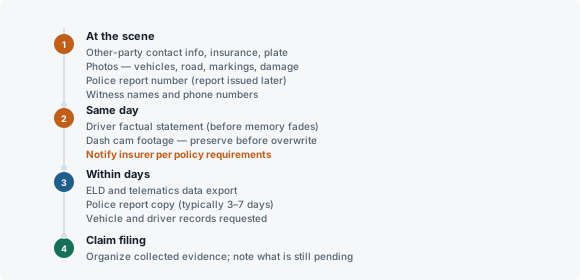
Scene documentation priorities
Photograph vehicle positions before any vehicle is moved. Capture the full road environment: traffic control devices, road markings, sight lines, skid marks or debris fields, weather conditions, and any contributing infrastructure factors.
Get witness contact information immediately — witnesses may leave before law enforcement arrives. A name and phone number noted at the scene is recoverable; a witness who walked away without being identified is not.
| Document | Collect when | Collected by |
|---|---|---|
| Other-party contact, insurance, plate | At the scene | Driver |
| Photos — vehicles, road, damage, markings | At the scene | Driver |
| Police report number | At the scene (report issued later) | Driver |
| Witness names and phone numbers | At the scene | Driver |
| Driver factual statement | Same day | Driver + safety contact |
| Dash cam footage | Same day (overwrite risk) | Safety contact |
| ELD and telematics data export | Within days | Safety contact |
| Police report copy | 3–7 days after incident | Safety contact |
| Repair estimates | After vehicle assessment | Owner / safety contact |
Late notification to the insurer can generate coverage questions — notify per policy requirements as soon as practical.
Your driver's account
The driver's immediate observations are important evidence. Collect a factual account — what the driver saw, when they saw it, what they did in response, and what happened next — as soon after the incident as practical. Memory degrades quickly, especially after a stressful event.
Do not coach the driver on what to say or how to frame their account. A factual statement of what the driver observed and did is what is needed. Whether and when that account is shared outside the company is a separate decision — route it through legal or safety contact before sharing.
Communications with outside parties
Notify your insurer promptly. Your policy will specify when and how. Late notification can generate coverage questions that early notification avoids.
At the scene, conversations with the other party should stay factual: exchanging contact information, insurance details, and vehicle identification. Fault analysis and coverage questions belong in the claim process. Recorded statements and informal conversations can both become part of the claim record, which is why your insurer and legal contact — not the other party's representatives — are the appropriate channel for substantive discussion.
Step-by-step checklist
- Collect the policy, unit number, driver details, and claim contact.
- Photograph damage, road conditions, cargo, documents, and scene markers.
- Keep repair estimates, tow records, bills of lading, and inspection notes.
- Document who received each file and when it was shared.
- Ask the insurer or qualified professional what else is required.
Evidence Handling
Preserve original files whenever possible. Record where each file came from, who handled it, and when it was shared.
Do not delete, modify, trim, or overwrite evidence because it seems unhelpful. Follow company policy, insurer instructions, and any legal hold process.
Insurance Boundary
This page is not insurance or claims advice. It cannot promise coverage, fault decisions, payment, or claim approval.
Coverage, deductibles, documentation requests, and deadlines depend on the policy, insurer, facts, and jurisdiction. Follow the claim contact's instructions and keep a copy of each submission.
Source Notes
- 49 CFR 390.15: Assistance in Investigations and Accident RegistereCFR · official · last checked 2026-06-08Supports: accident-recordkeeping, incident-documentation, internal-review
Supports general accident register and recordkeeping context. Readers must check current rule text.
- 49 CFR 396.3: Inspection, Repair, and MaintenanceeCFR · official · last checked 2026-06-08Supports: maintenance-records, vehicle-condition, claim-documentation
Supports general references to maintenance records. Readers should check current rules and policy.
- How to File an Auto Insurance ClaimInsurance Information Institute · industry · last checked 2026-06-08Supports: insurance-claim-documentation, claim-communication
General insurance education reference. It is not carrier-specific claim advice and does not promise outcomes.
- Auto InsuranceNAIC · reference · last checked 2026-06-08Supports: insurance-basics, coverage-terms, deductible
General consumer insurance reference for terminology. Commercial trucking policies require separate review.
For source notes and related resources, visit https://www.crashprooftruck.com